

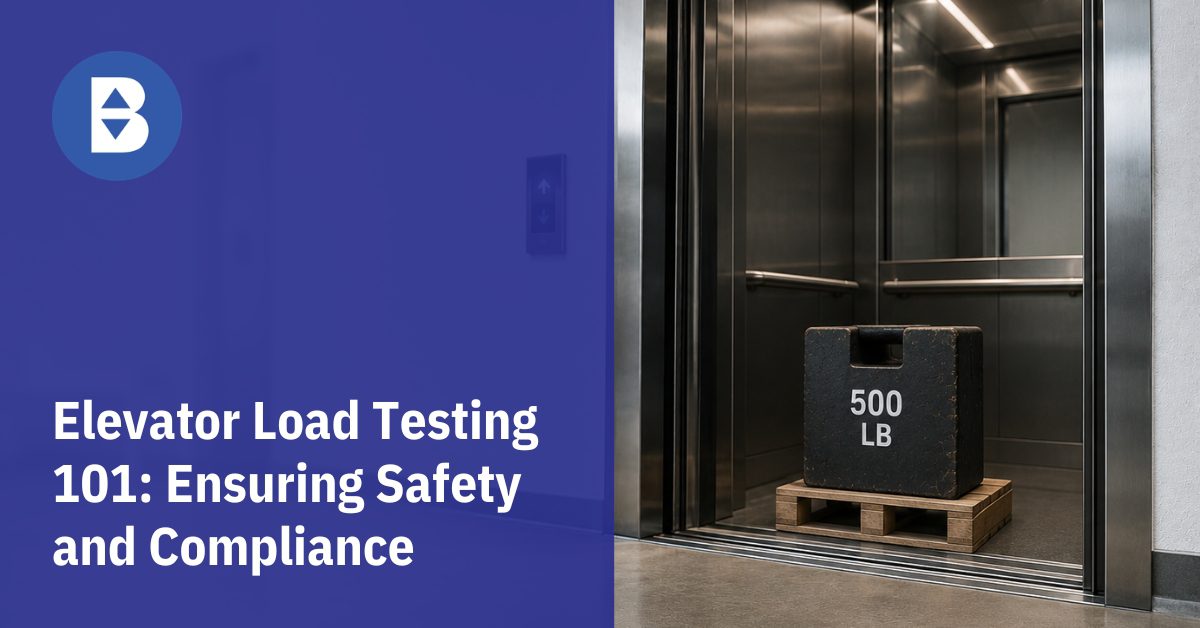
Elevator Load Testing 101: Ensuring Safety and Compliance
August 11, 2026Let’s face it, no one really thinks too much about elevators until they aren’t working or worse, they’re stuck in one. That’s when passengers start thinking about how the technology holds them and what is stopping the elevator car from plummeting to the ground.
Thankfully, there is a science to these questions and it involves a test called the Elevator Load Test.
What is an Elevator Load Test?
At its core, an elevator load test is a mandatory safety evaluation designed to push a lift to its absolute limits. By loading the cab with calibrated weights, typically 125% of its rated capacity, technicians safely verify that the brakes, ropes, and emergency stop systems function flawlessly under maximum speed and stress.

Why an Elevator Load Test Matters
While we have discussed The Importance of an Elevator Load Test in the past, it is important enough to review.
Two of the most important reasons for conducting an elevator load test are strict code compliance and system verification. First, staying compliant with state and municipal safety regulations, such as ASME A17.1 codes, is mandatory to legally operate a building and avoid costly fines, litigation, or sudden shutdowns. Second, the test serves as a critical real-world verification of the machinery itself; by pushing the elevator beyond its normal daily parameters, technicians can ensure that the braking systems, cables, and governors won’t experience dangerous slippage when placed under extreme stress.
How is an Elevator Load Test Conducted?
The elevator load testing process is a highly coordinated procedure that shifts the machinery from standard operation to extreme stress testing.
It begins with preparation, where normal public access is disabled, doors are tightly secured, and calibrated test weights are wheeled into the cab. Once loaded to an over-capacity state, typically 125% of its rated limit, the real stress testing begins. Technicians run the elevator through a grueling sequence of fast ascents, sharp descents, and sudden emergency stops to precisely measure acceleration, deceleration, and braking distances. Finally, the weights are removed for a no-load testing phase, running the empty cab through its paces to verify that the entire system functions flawlessly across all operating parameters.
 What is the Testing Frequency?
 What is the Testing Frequency?
 While state and local regulations require building owners to conduct frequent inspections to maintain up-to-code safety certifications, full-load tests don’t need to be conducted every year. Instead, standard annual inspections focus on general mechanics and operations, whereas the more rigorous full-load test is only required once every five years. This five-year rule applies equally to hydraulic elevators and traction-cable systems.
Regular elevator load testing is a vital component of maintaining a safe, compliant building, ensuring your systems can withstand stress beyond their standard operating capacity. By conducting these rigorous tests every five years, you not only meet mandatory safety codes like ASME A17.1 but also gain the peace of mind that comes from verifying your brakes, cables, and emergency systems under real-world stress. Protecting your tenants and your equipment requires expert attention, and we are here to help. If you are due for your next inspection or need guidance on your building’s compliance schedule, contact Buckley Elevators today to ensure your systems remain safe and reliable.